
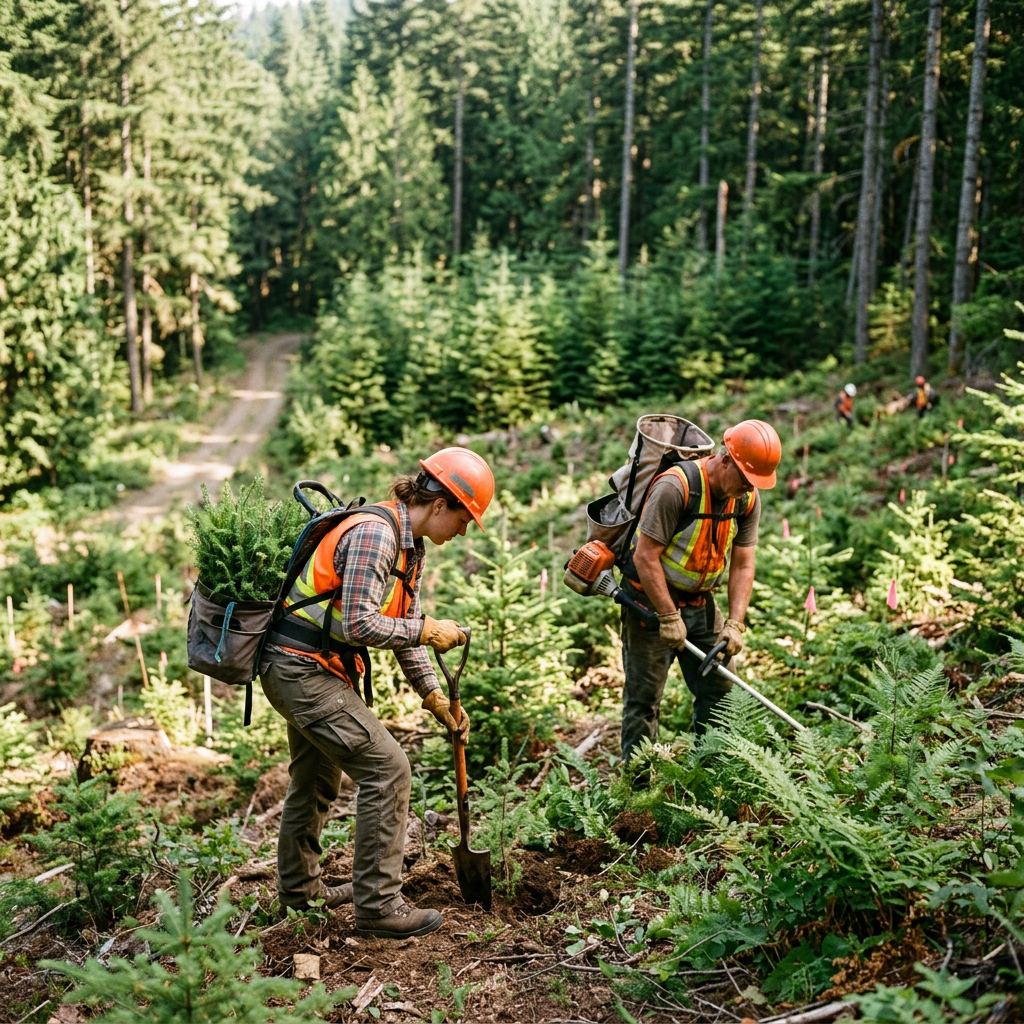
How America’s forest products industry helped build a legacy of productive working forests—and why the next generation of markets matters.
SilvaCurrent | National Forest Products Week | October 2026
America’s forests have a remarkable story to tell. And it isn’t simply one of trees being cut down.
It’s a story of forests returning, timber inventories growing, rural communities building livelihoods around wood, and generations of landowners finding reasons to keep their land forested.
At the center of that story is an industry that turns a renewable resource into something people need—and creates economic value in growing it again.
The industry that helped build America
Long before engineered wood, renewable fuels, or biobased chemicals, American forests supplied the essentials of a growing nation:
- Homes and cities: Lumber, beams, shingles, and flooring.
- Transportation and trade: Ships, railroad ties, bridges, and barrels.
- Energy and manufacturing: Firewood, charcoal, and industrial fuel.
- Everyday products: Paper, packaging, tissue, and eventually engineered wood.
The industry grew from the Northeast and Great Lakes to the South and Pacific Northwest, supporting mills, logging businesses, trucking companies, and entire rural communities.
Then came an important shift: wood that wasn’t suitable for lumber became valuable, too.
Pulp and paper mills created demand for smaller trees, lower-grade wood, and manufacturing byproducts. Instead of relying on a single product, forest owners could sell different parts of their timber resource into complementary markets.
That helped make forest management—and regeneration—more financially practical.
More forests. More standing timber.
Here’s something worth celebrating during National Forest Products Week: America’s forest resource has endured and, by important measures, grown.
In the early 1900s, the United States had roughly 754 million acres of forestland, following centuries of clearing for agriculture, settlement, and timber.
By 2017, that figure was approximately 765 million acres.
And the amount of standing timber tells an even more interesting story.
USDA Forest Service inventories show that while national forest acreage changed relatively little after the 1950s, growing-stock timber volume increased substantially.
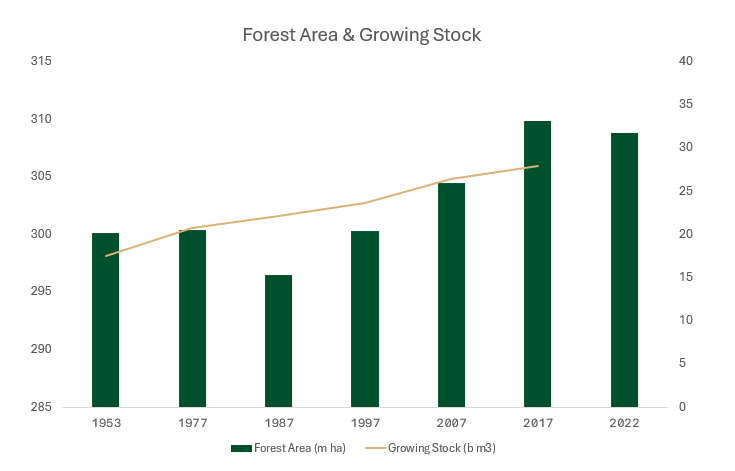
Source: USDA Forest Service, Forest Resources of the United States, 2017 and 2022. See data notes below.
How did that happen?
- Former farmland returned to forest through natural regeneration and planting.
- Forestry science improved tree growth, regeneration, and management.
- Conservation policies and landowner investments supported forest recovery.
- Forest products markets helped make growing trees a worthwhile long-term investment.
The result is a forest economy built around a resource that can be harvested, regenerated, and harvested again.
That’s a fundamentally different proposition from permanently clearing land.
Stewardship became part of the business
America’s forestry history wasn’t always a conservation success story. Early logging often left damaged landscapes, and destructive fires followed in some regions.
But forestry evolved.
The establishment of the U.S. Forest Service in 1905, advances in silviculture, and decades of public and private investment helped move the industry toward sustained-yield management.
Today, forest stewardship includes much more than timber production:
- Regeneration and long-term productivity
- Water quality and wildlife habitat
- Soil protection and biodiversity
- Recreation, carbon storage, and wildfire resilience
Certification programs such as the Sustainable Forestry Initiative, Forest Stewardship Council, and American Tree Farm System have helped formalize expectations for responsible management.
Forest ownership evolved, too. Timberland became a recognized investment asset, with timberland investment management organizations (TIMOs) and timberland real estate investment trusts (REITs) managing forests for long-term returns.
Not every ownership model delivers the same outcomes. But the underlying principle is powerful: a forest can generate economic value repeatedly while remaining a forest.
And those returns can help pay for stewardship.
A working forest needs working markets
Here’s where the story gets interesting.
A forest doesn’t grow only premium sawlogs. It also produces small-diameter trees, lower-grade stems, thinning material, and residues.
Different markets give those materials different destinations.
A sawmill might purchase larger logs for lumber. A pulp mill might buy smaller trees and wood chips. Other manufacturers and energy producers may use bark, sawdust, or residual fiber.
Together, these outlets can help support a more complete forest-management system.
When a market disappears, the effects reach beyond the mill gate:
- Landowners may earn less from timber sales.
- Loggers and truckers may travel farther to find buyers.
- Thinning and other forest treatments may become harder to finance.
- Rural communities lose jobs, businesses, and specialized expertise.
Recent pulp and paper mill closures are reminders of how quickly that economic network can change.
For a closer look, read SilvaCurrent’s The Ripple Effects of a Mill Closure, which explores the impacts on regional wood supply chains, and visit the American Forest Fuels Alliance for forest-market advocacy and industry resources, including a comprehensive list of pulp and sawmill closures since 2015.
The point isn’t that every forest needs a mill nearby. It’s that healthy working-forest economies depend on having enough viable outlets for the wood they produce.
The bigger risk: when forests become worth more as something else
Harvesting timber and permanently converting forestland are not the same thing.
A working forest can be harvested and regenerated while remaining forestland. But when land becomes a subdivision, industrial site, or another permanent use, the economics—and often the landscape—change.
Today, working forests compete with:
- Residential and commercial development
- Agriculture and infrastructure
- Utility-scale energy projects, including solar and data centers
USDA research found that, among rural utility-scale solar projects installed from 2012 to 2020, 23% in the Atlantic region and 17% in the South were located on previously forested land.
That doesn’t mean declining timber markets caused those conversions. Land-use decisions involve many factors.
But it does raise an important question: When landowners have fewer ways to earn income from forests, how much harder does it become to justify keeping that land in forest use?
Recent changes in forest acreage deserve attention through this lens. Forestland conversion, not simply the harvesting of trees for forest products, is a critical distinction in understanding permanent forest loss.
Strong markets cannot prevent every conversion. They can, however, give landowners another financially viable choice.
Keeping the next generation in the woods
There’s another part of the forest economy that’s easy to overlook: the people.
Foresters, loggers, truck drivers, nursery operators, and mill workers carry specialized knowledge built over decades, often within family businesses.
Modern equipment, mapping technology, and digital supply-chain systems have changed their work. But the cost of entering the industry remains high, and workforce succession is a growing concern.
New technology cannot replace a skilled workforce overnight.
Markets support more than trees. They support the businesses and people needed to manage them.
And those people will be essential to the industry’s next chapter.
New products. New reasons to keep forests growing.
The next generation of forest products won’t replace everything the traditional industry produces. Nor should it.
The opportunity is to build on an established forest economy with new markets for materials that are currently underused or losing traditional outlets.
Potential growth areas include:
- Renewable fuels and energy: New uses for suitable low-grade wood and residual biomass.
- Biobased chemicals and materials: Alternatives to fossil-derived industrial inputs.
- Lignin products and advanced biomaterials: Higher-value applications for wood components.
- Biochar, carbon, and other emerging products: Additional pathways for selected residual streams.
Not every technology is commercially ready. New markets still need reliable feedstock, competitive economics, infrastructure, sustainability safeguards, and investment.
But the opportunity is real: turn more of what forests sustainably produce into products people value, while strengthening the economics of keeping forests forested.
That’s also the thinking behind the American Forest Fuels Alliance’s work to expand responsible forest-to-fuels markets.
Keeping forests forested
National Forest Products Week is a chance to celebrate more than lumber, paper, or manufacturing output.
It’s a chance to recognize an industry that has helped generations of Americans make a living from forests without permanently losing them.
America’s working forests are a legacy of natural regeneration, conservation, scientific progress, private investment, and people who saw long-term value in growing trees.
The next challenge is making sure that value continues.
Because keeping forests forested isn’t just about protecting what grows there. It’s about sustaining the markets, people, and stewardship that give those forests a future.
Data notes and sources
- Historical forest area and timber volume: USDA Forest Service, Forest Resources of the United States, 2017 and Forest Resources of the United States, 2022 (published 2026). Historical figures are estimates, and inventory methods have evolved. Forest area and growing-stock volume use different land bases; growing stock generally refers to qualifying trees on timberland. The 2022 growing-stock endpoint and revised historical series should be verified before the final graphic is published.
- Forest recovery and health: Increased national growing-stock volume does not necessarily mean every forest is healthier. Forest conditions vary by region, species, density, climate, disturbance, and management history. Forest recovery also reflects changing agricultural land use, natural regeneration, conservation, and public investment—not timber markets alone.
- Forestland conversion: USDA Forest Service, Forest Inventory and Analysis and Forests on the Edge; USDA Economic Research Service, Utility-Scale Solar and Wind Development in Rural Areas: Land Cover Change (2009–20) (2024). Solar percentages describe the prior land cover of project sites, not the proportion of total forestland converted or acres converted. The available evidence does not establish that weaker timber markets caused those specific conversions.
- Markets and management: Timber markets can help offset the costs of thinning, regeneration, and other management activities, but the ecological benefits of particular treatments depend on local forest conditions. Not all thinning improves wildfire resilience, and not all low-grade material is economically or environmentally suitable for removal.
- Forest ownership and workforce: USDA Forest Service National Woodland Owner Survey; Bureau of Labor Statistics, Occupational Outlook Handbook; Sustainable Forestry Initiative; Forest Stewardship Council; American Tree Farm System. Ownership objectives, investment horizons, and forest-management practices vary widely.
- Further reading: SilvaCurrent — The Ripple Effects of a Mill Closure | American Forest Fuels Alliance | USDA Forest Resources of the United States, 2022 | USDA ERS Solar Land-Cover Research


Leave a Reply