
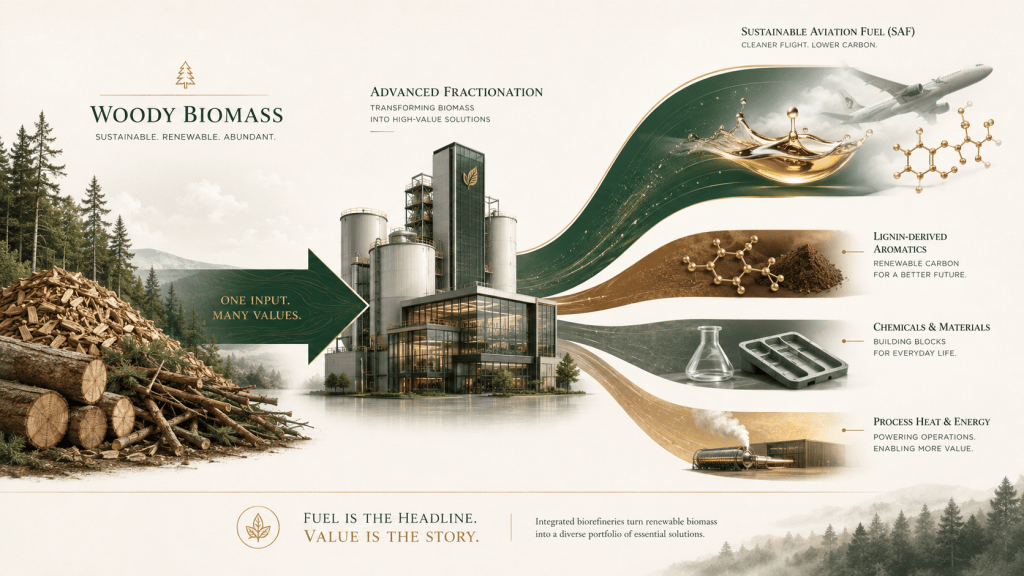
Bioindustrial projects are usually introduced through the product people want to talk about.
Sustainable aviation fuel. Renewable diesel. Ethanol. Renewable natural gas. A new chemical intermediate.
That is understandable. The flagship product carries the story. It often carries the policy incentive, too. It is what appears in the project announcement, the investor deck and the headline capacity number.
The plant itself is more complicated.
Every ton of biomass entering a facility has to go somewhere. Some becomes the molecule the project was built around. The rest becomes another product, another intermediate, an internal energy stream or a disposal cost.
Investors eventually have to finance all of it.
A technology that turns 70 percent of its feedstock into an attractive primary product still needs an economic answer for the other 30 percent. Sometimes that answer makes the model substantially better. Sometimes it quietly undermines it.
This is where lignin gets interesting.
The Joint BioEnergy Institute recently convened researchers from DOE’s four Bioenergy Research Centers for an Inter-BRC Lignin Workshop. Its second day was deliberately framed as an Industry Listening Day, with participation from BASF, Dow, Sulzer, ErgBio and Algenesis Labs. The purpose was unusually practical: bring industrial requirements into the research process earlier, particularly product specifications and techno-economic considerations that will determine whether lignin technologies can eventually be adopted at scale.
That is an important shift.
There has never been a shortage of things that lignin can theoretically become. The harder problem is developing a lignin stream that a particular customer can actually use, consistently, in sufficient volume, at a price that works for both sides.
That requires far more specificity than saying a project will “valorize lignin.”
The lignin has to fit the market
Lignin is often discussed as though it were a standardized commodity. It is anything but.
Its properties depend on the original biomass, how it was separated, the severity of the pretreatment process and what happened chemically along the way. Sulfur content can matter. Molecular weight distribution matters. Ash and carbohydrate contamination can matter. So do functional groups, solubility, particle form, thermal behavior and consistency from one production run to the next.
Those characteristics begin narrowing the market long before anyone starts negotiating price.
A highly functional, relatively clean lignin stream may have a path into specialty resins, polymer systems, carbon materials or chemical intermediates where customers will pay more for performance. That higher price comes with higher expectations. Purity may have to be tightly controlled. Batch variability becomes a commercial issue. Qualification can take months or years.
Move down the value spectrum and the potential markets tend to become larger. Adhesives, binders, dispersants, composite materials, asphalt modification and other industrial applications can offer substantially more volume.
The economics change with them.
A specialty market may support an attractive price but absorb relatively little material. A large industrial market may have plenty of capacity to absorb production but little tolerance for a costly feedstock or elaborate upgrading step.
At the bottom of the value ladder sits the application the pulp industry has relied on for decades: energy.
Globally, the pulp and paper and bioethanol industries generate tens of millions of tons of lignin annually, yet the overwhelming majority is still burned for process heat and energy rather than sold into higher-value products. A recent review on lignin-to-jet conversion cites global lignin generation of roughly 50 to 70 million tons per year, with more than 98 percent still used for combustion.
Burning lignin is sometimes characterized as a failure to extract its full value. Inside a kraft pulp mill, that judgment can be too simplistic. The recovery boiler is central to the mill’s chemical and energy system. Black liquor supplies energy while also enabling recovery of pulping chemicals.
There are circumstances, however, where recovering lignin begins to change the mill economics.
A recovery boiler can become a constraint on pulp production. Removing some lignin upstream of the boiler reduces the solids that have to pass through it. In the right mill, lignin extraction can help relieve that bottleneck and create room for additional pulp production without immediately investing in more recovery capacity.
Now the economics are not simply the selling price of lignin.
There may be value in the recovered product, value in increased pulp throughput and value in deferred capital.
But once that lignin comes out of the mill’s internal energy loop, somebody needs to buy it.
And kraft lignin comes with characteristics, including sulfur and the chemical history of the kraft process, that can limit the markets where it competes most easily. Pretreatment decisions made years earlier in the process suddenly become relevant to the potential buyer standing at the other end.
This is why generalized lignin price curves can be dangerous in project models.
There is no particularly useful answer to the question, “What is lignin worth?”
A much better question is: What is this lignin worth, in this specification, at this volume, to a customer capable of using it?
One particularly interesting path leads back into the fuel tank
Lignin’s aromatic structure is creating another possibility.
Many SAF pathways produce predominantly linear and branched paraffins. Those molecules are valuable, but conventional jet fuel contains a much broader molecular mix. Cyclic hydrocarbons contribute important properties including fuel density, volumetric energy content and compatibility with aircraft fuel systems.
Lignin begins with something many other renewable feedstocks have to work much harder to create: rings.
It is the largest abundant renewable source of aromatic structures in nature. Recent research has focused on depolymerizing lignin and then upgrading those intermediates through hydrodeoxygenation into mono-, bi- and tricyclic hydrocarbons in the jet-fuel boiling range.
A July 2026 review in Chemical Engineering Journal examined aqueous-phase routes capable of simultaneously depolymerizing and hydrodeoxygenating lignin. The resulting fuels can contain alkyl-substituted mono-, bi- and tricyclohexanes, with potentially useful density and energy characteristics. The authors specifically frame integration with cellulosic biorefineries as an opportunity to increase carbon conversion and improve overall project economics.
The technical promise is real.
So are the remaining hurdles.
Catalyst durability and cost are unresolved commercialization questions. Hydrogen requirements can be significant. The structural heterogeneity of lignin affects reaction behavior. Final fuel properties depend heavily on the distribution of cyclic molecules produced, and current lignin-derived jet fuels still face compatibility and certification challenges.
This is precisely why the upstream lignin matters so much.
The conversion technology cannot be viewed independently from the lignin arriving at its inlet.
How was it separated? How condensed is it? What impurities are present? Has upstream processing preserved the chemical features the downstream process needs? How much additional conditioning will be necessary before it reaches the reactor?
The front end and tail end of the biorefinery are tied together economically, even when different companies own the technologies.
That connection is easy to underestimate.
Higher value does not automatically mean better economics
There is a recurring temptation in co-product development to identify the market with the highest published price and build the model around it.
A specialty application selling for several multiples of a fuel or binder can look transformative in a spreadsheet.
Commercial markets impose constraints that spreadsheets often hide.
A customer might happily test a few kilograms of a novel lignin and have no interest in contracting for 20,000 tons per year.
The price quoted for a highly refined specialty grade may have little bearing on the price available to an industrial stream produced continuously at commercial scale.
A market may be technically attractive but not willing to pay the premium.
Another may require twelve to twenty-four months of product qualification.
A customer may like the performance and still refuse to change a formulation because the switching cost outweighs the savings.
Sometimes the lower-price market produces better project economics because it can absorb volume quickly and requires little additional processing.
Sometimes the specialty application is worth pursuing because the volume matches the plant and the customer has a compelling reason to adopt it.
Frequently, the answer is a portfolio.
Some material may find its way into premium applications. Larger volumes move into broader industrial markets. Off-specification material retains an energy outlet.
That kind of product segmentation resembles what conventional refining industries have done for a very long time.
The biorefinery has to learn the same discipline.
A changing pulp sector complicates the picture
The commercial lignin conversation also depends on where future lignin supply comes from.
Most of today’s commercially available industrial lignin still originates in the pulp and paper industry. Cellulosic ethanol and other lignocellulosic biorefineries also generate lignin-rich fractions, sometimes in substantial quantities, but historically most have used that material internally for process heat and power rather than recovering it as a merchant co-product.
While pulp & paper capacity continues to rationalize in North America, removing potential sources of recoverable lignin, a future wave of lignocellulosic biorefineries could create entirely new sources of industrial lignin, potentially with characteristics very different from conventional kraft lignin. But those markets will only develop if lignin recovery, quality and downstream use are considered early enough in the process design.
Traditional industrial lignin supply can shrink in some regions at the same time that emerging biorefineries begin producing new lignin streams with entirely different chemical characteristics.
Those new streams may ultimately prove better suited for some high-value applications precisely because they were produced through processes designed to preserve lignin functionality.
That opportunity depends on decisions being made today.
If a portion of that lignin can instead be converted into a higher-value fuel such as a jet-fuel blendstock, the economics of the entire biorefinery begin to change. New attention is looking at integration with cellulosic ethanol as a way to improve carbon utilization and overall economic performance rather than treating lignin primarily as boiler fuel.
That does not mean the boiler disappears from the equation. The energy balance still has to close. Steam and power previously supplied by lignin have to come from somewhere, and the additional upgrading process brings its own hydrogen, catalyst, equipment and operating requirements.
The commercial question therefore becomes more interesting than simply asking whether lignin can be worth more as SAF than as fuel for a boiler.
It becomes a whole-system optimization problem: how much lignin should remain an energy source, how much can be economically upgraded, what products can the market absorb, and which combination creates the strongest economics for the facility as a whole?
That is exactly where co-product strategy starts to influence whether a biorefinery works on paper or works as a business.
A process designed primarily to maximize the flagship fuel yield may leave behind a lignin that is difficult to upgrade later.
A slightly different pretreatment strategy may preserve characteristics that open an entirely different downstream market.
Neither choice is automatically correct. The economic answer depends on what the full plant is trying to become.
Which brings us back to the mass balance.
Commercialization starts to look like a network
A co-product strategy rarely belongs to one company.
The feedstock supplier influences material consistency. The pretreatment provider influences lignin quality. The primary conversion process determines what fractions remain available. A downstream upgrading technology may impose another set of specifications. The eventual customer brings its own qualification requirements.
Someone has to connect those pieces.
For first-of-a-kind (FOAK) projects, that coordination can become as important as the underlying chemistry.
A future offtaker may need to enter the conversation while the process is still being optimized. A technology company may discover that a strategic customer is more valuable as a development partner or investor than as a conventional buyer.
Some projects may benefit from joint ventures. Others from technology licensing, toll processing, minority strategic investment or long-term offtake arrangements that give capital providers more confidence in the market.
There is no universal structure.
What does seem increasingly clear is that FOAK bioindustrial projects need partners willing to travel farther together than a conventional supplier-customer relationship normally requires.
Commercialization is rarely linear.
Technology trials produce unexpected results. Product specifications evolve. Customers test material and ask for changes. Scale-up exposes impurities that barely mattered in the laboratory. The market that originally anchored the business case may prove slower to enter than a secondary application nobody regarded as particularly glamorous at the outset.
Relationships matter during those moments.
So does patience.
A credible partner understands that product validation takes time, but also knows when a technology is moving toward a real commercial specification rather than remaining indefinitely experimental.
Mutual trust becomes an economic asset because every party is being asked to make decisions before all of the technical and market uncertainty has disappeared.
JBEI’s decision to bring industrial participants into lignin research earlier reflects that reality. Product specifications and techno-economic requirements are far cheaper to discover before a process has been locked into commercial equipment.
The other 30 percent deserves a seat at the table
When evaluating a new biorefinery, it is tempting to spend most of the discussion on conversion efficiency to the primary product.
In wood, approximately 30% of the mass is composed of lignin.
Where does it go? What condition is it in when it gets there? Who has tested it? How large is the realistic market? What processing still stands between the plant gate and the customer’s specification? How long will qualification take? What happens when the premium market cannot absorb another 10,000 tons?
Those questions can reshape the project.
They may influence pretreatment. They may change equipment selection. They may suggest a different location. They may identify a strategic partner who should have been involved much earlier.
And they may reveal revenue that turns a marginal project into a financeable one.
Some of today’s FOAK bioindustrial technologies will succeed or fail on precisely these questions.
There is tremendous value sitting in the fractions that have historically been treated as residuals. Capturing it will require more than discovering another use for lignin, cellulose, ash or any other co-product.
The harder work lies in matching the right material, produced through the right process, with a market capable of accepting the actual volume and specification a commercial plant will generate.
That work happens across company boundaries.
It requires technology developers, feedstock suppliers, processors, customers and capital providers to understand each other’s constraints earlier than they traditionally have.
And sometimes it requires staying at the table through several rounds of trials before the commercial fit becomes obvious.
For companies developing new bioindustrial processes, the most important revenue stream may not be the one printed in the project name.
It may be hiding in the other 30 percent.
SilvaCurrent works with emerging bioindustrial companies and their partners on the commercial questions surrounding feedstock, market fit, co-product strategy, offtake and value-chain development. I am particularly interested in conversations where a technically promising process is beginning to confront the harder question of how the full mass balance becomes a commercial business.
Established Roots. Emerging Industries.


Leave a Reply