About SilvaCurrent
Forest and bioindustrial intelligence partner turning complex assets, residuals, and markets into clear, actionable decisions.

Established roots.
Emerging industries.

Megan McCormick
Founder & Principal
SilvaCurrent was founded by Megan McCormick to help established forest-industry capabilities and emerging bioindustrial opportunities find one another—and to help companies make better decisions about what comes next.
For Megan, this work is both professional and personal.
She has always been drawn to forests: to their beauty, complexity and capacity to sustain communities across generations. Her connection to forested landscapes has grown through years spent living and working around the industry, as well as through time exploring forests with her family—from the Pacific Northwest and Vancouver to Yosemite, the Appalachian Mountains, Shenandoah National Park, where her husband proposed, and most recently Great Smoky Mountains National Park.
These places have reinforced a belief that has shaped her career:
Keeping forests forested requires more than appreciating them. It requires durable markets, responsible management and a forest economy capable of creating value across generations.
When working forests remain economically viable, landowners have stronger reasons to continue managing them as forests rather than converting them to other uses. Healthy markets also support the foresters, loggers, truckers, mills, manufacturers and rural communities whose knowledge and infrastructure make sustainable forest management possible.
SilvaCurrent exists to strengthen those connectionss
A career built at the intersection of forests, markets and policy
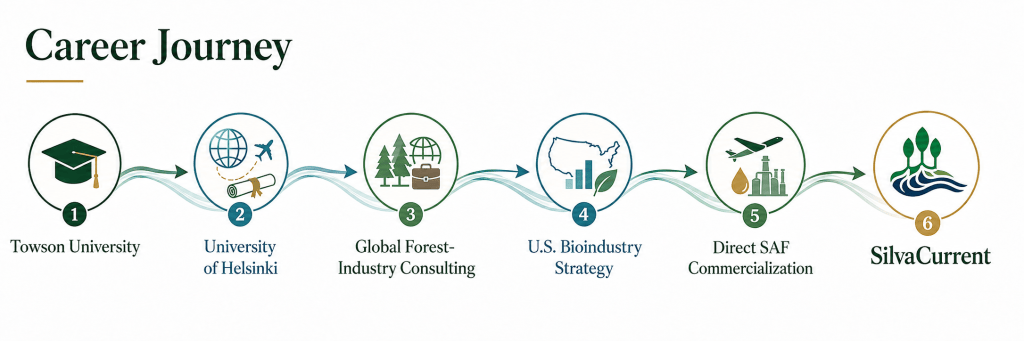
Megan began her professional path at Towson University, where she studied Environmental Studies and Political Science. Together, those disciplines gave her an early understanding that environmental outcomes are shaped not only by ecology, but by economics, public policy, regulation, institutions and the decisions made by people and businesses.
Her interest in the relationship between forests and markets led her to Finland and the University of Helsinki, where she completed graduate studies in Forest Policy and Business within the university’s Master’s program in Forest Sciences.
The program offered something close to an MBA for the forest sector: an interdisciplinary education in forest economics, business strategy, policy, resource management and the broader social systems surrounding forests. It also placed her within one of the world’s most advanced forest-industry regions.
In Scandinavia, she saw how established forest companies could combine operational excellence, long-term resource stewardship and continual product innovation. Pulp, paper and lumber were not treated as the limits of the forest economy. They were part of an evolving industrial platform capable of producing advanced packaging, engineered materials, chemicals, energy products and other higher-value applications from wood, fiber and industrial co-products.
That perspective became the foundation of her career.
From global forest-industry strategy to market execution
Megan began her forest-industry consulting career with the organization now known as AFRY, working first in Finland and later in the United States.
AFRY’s bioindustry consulting practice operates across forest and bioeconomy value chains, from forestry and biomass supply through pulp, paper, packaging, biomaterials and novel end uses.
Working within that environment gave Megan an unusually broad view of the industry. She supported major forest-products companies, investors, manufacturers, technology developers and emerging businesses as they evaluated markets, diversified product portfolios, assessed technologies and explored opportunities beyond traditional forest products.
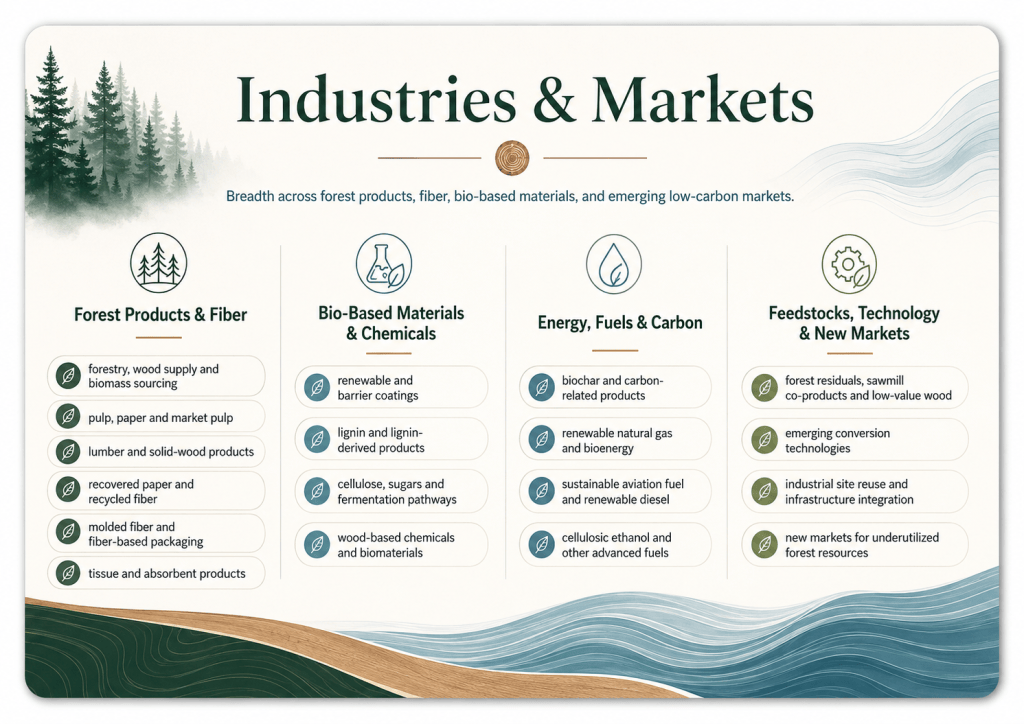
Projects ranged from market assessments and competitive analyses to commercial due diligence, feedstock studies, product-development strategies, technology evaluations, investment support, partnership development and market-entry planning.
After returning to the United States, Megan expanded her work across North American markets while continuing to draw on the international perspective she developed in Finland. She worked with established companies seeking new growth platforms and emerging businesses trying to understand how their technologies could fit within existing forest-industry systems.
Over time, she became known for connecting information that is too often evaluated separately: market demand, resource availability, feedstock quality, mill infrastructure, technology readiness, policy eligibility, supply-chain behavior and the commercial realities facing the people expected to make a project work.
Moving from advisory work into commercialization
Most recently, Megan made the deliberate move from external consulting into a direct, hands-on commercialization role with a wood-based biofuels technology company pursuing sustainable aviation fuel and other renewable products through project development and technology licensing.
That experience brought her closer to the everyday decisions that determine whether a promising technology can become a viable operating business.
She worked across commercialization strategy, feedstock development, technology integration, project siting, partnerships and supply-chain planning. The role required her to confront, in real time, the practical questions that appear between a compelling concept and a bankable project:
- Which materials are technically suitable?
- Which feedstocks meet regulatory and sustainability requirements?
- What preprocessing is necessary, and who can reliably perform it?
- How will moisture, particle size, ash, contamination and seasonal variability affect conversion performance?
- Can the material be traced through an auditable chain of custody?
- How should pricing, risk allocation and contract terms be structured?
- What volumes are genuinely available without disrupting established users?
- Can existing mills, terminals, utilities and transportation networks support the project?
- Where do laboratory results, pilot operations and commercial assumptions diverge?
- Which integration risks are manageable, and which could undermine the project?
- How do funding requirements, policy incentives and feedstock eligibility affect the development strategy?
- What must be demonstrated before suppliers, customers, investors and strategic partners will commit?
These are not questions that can be answered through market reports alone.
They require direct conversations with foresters, mill operators, procurement teams, landowners, loggers, engineers, technology providers, laboratories, investors, policymakers and project developers. They also require an appreciation for the limits of existing supply chains—and respect for the companies and people already operating within them.
That experience strengthened Megan’s conviction that emerging bioindustries cannot be built alongside the forest industry as though the existing system were merely a source of inexpensive raw material.
They must be built with it.
Connecting the dots across the forest economy
Throughout her career, Megan has been entrusted by major forest-industry companies, emerging technology businesses, CEOs, engineers, foresters, investors and project teams to help them:
- understand unfamiliar markets;
- identify meaningful opportunities;
- assess commercial, technical and supply risks;
- evaluate feedstock and infrastructure;
- develop market-entry strategies;
- diversify product portfolios;
- position technologies for growth;
- identify potential customers and partners;
- translate complex technical concepts into commercial narratives;
- and connect individual opportunities to the wider forest-industry ecosystem.
She is deeply grateful to the people who have shared their expertise with her along the way.
Much of her knowledge was built not only through formal research, but through mill visits, project meetings, supplier conversations, technical reviews and candid discussions with people who have spent their careers growing, harvesting, transporting, processing and transforming wood.
That accumulated experience—and the trust behind it—is central to SilvaCurrent.
Megan maintains relationships across the traditional forest-products industry and the emerging bioeconomy, connecting companies, technologies, resources and perspectives that may not otherwise find one another. Her network includes participants across forestry, manufacturing, technology development, renewable fuels, biomaterials, chemicals, packaging, finance, policy and rural economic development.
A recognized industry voice
Megan regularly contributes to industry conversations through conference presentations, panels, working groups and professional forums.
Her speaking engagements have included the International Molded Fiber Association Conference in Scottsdale, Arizona, where she joined a panel discussing technology, business models, competitiveness and regulatory drivers shaping molded-fiber markets; the Advanced Woody Biomass Association; the International Biomass Conference & Expo; and the U.S. Forest Service Utilization and Markets Conference for southern forestry leaders, among other industry events.
AFRY’s coverage of the 2023 International Molded Fiber Association Conference highlights her participation in a panel examining how new technologies, business models and regulatory factors could influence the competitiveness and future demand for molded-fiber products.
Across these engagements, her focus remains consistent:
- securing durable and appropriate fiber supply;
- understanding the broader ecosystem surrounding that supply;
- integrating new projects into existing forest-industry infrastructure;
- identifying the conditions required for successful market entry;
- and building strategies that respect both emerging opportunities and established markets.
Why SilvaCurrent
SilvaCurrent brings together the two perspectives that have defined Megan’s career.
The first is a deep respect for the established forest industry: its people, assets, supply chains, knowledge and essential role in maintaining economically productive forestland.
The second is a belief in the extraordinary potential of emerging forest-based fuels, chemicals, materials and technologies to create new value from forest resources and industrial co-products.
But potential alone is not enough.
Successful projects require the right resource, technology, site, partners, policies, markets and timing. They require an understanding of how each decision affects the rest of the system. Most importantly, they require trusted relationships with the people who know the forest economy from the inside.
SilvaCurrent helps clients see that whole picture.
Through market intelligence, strategic advisory, opportunity assessment, industry relationships and practical commercialization support, Megan helps companies connect established strengths to emerging possibilities.
Her purpose is not simply to identify where wood may be available.
It is to understand the complete ecosystem around it—and to help build markets that keep forests managed, communities productive and forestland durable, sustainable and profitable for generations to come.
How SilvaCurrent Works
SilvaCurrent is an independent advisory practice led directly by Megan McCormick.
Each engagement begins with the client’s decision, question, or market opportunity. From there, SilvaCurrent develops a focused research and advisory approach drawing on industry experience, public information, primary research, professional relationships, and client-provided data.
Depending on the assignment, the work may include market and supply-chain research, interviews with industry participants, facility and infrastructure analysis, feedstock evaluation, opportunity screening, commercial assessment, or coordination with specialized technical and data resources.
Some projects may require licensed databases, geospatial tools, travel, laboratory work, or outside technical expertise. When those resources are necessary, they are identified transparently and incorporated into the project scope and budget rather than assumed to be part of every engagement.
Clients work directly with Megan throughout the assignment, with clear communication, confidentiality, and research tailored to the decisions they need to make.
How We Deliver Forest Intelligence
We blend geospatial analysis, on-the-ground experience, and market modeling in collaborative engagements that stay confidential, transparent, and tightly aligned with client decisions.